


THE SYMBOL ATLAS · No. 01 — October 27, 2026
Five points. One continuous line. Few shapes can provoke as many assumptions as the pentagram. On a pendant it might look protective. On a book cover it might signal witchcraft. Tilt it upside down in a horror film and suddenly the soundtrack thinks it has explained everything.
The symbol is older, more complicated, and far more interesting than its modern costume. If you want to understand a pentacle, the useful question is not simply “What does it mean?” but “Who is using it, and when?”
Pentagram or pentacle: what is the difference?
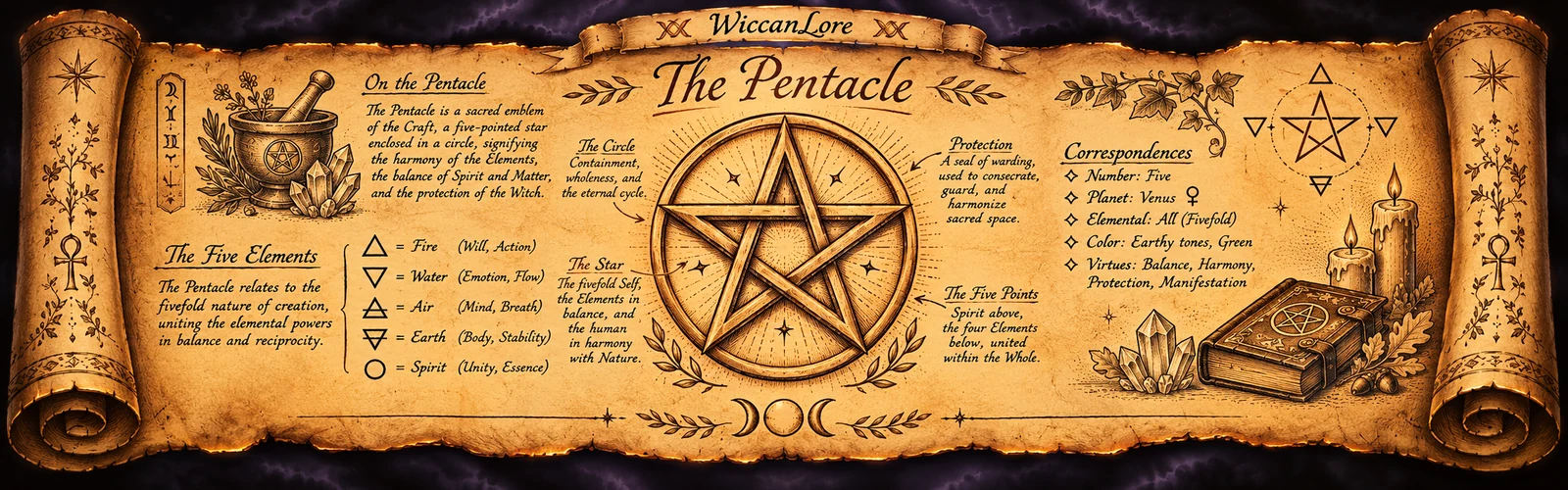
A pentagram is the five-pointed star formed by five intersecting straight strokes. It can be drawn as one unbroken figure. A pentacle, in contemporary Wiccan jewelry and illustration, often means that star enclosed by a circle. The terms are frequently used interchangeably in popular writing, and “pentacle” has also had broader historical meanings as a ritual or talismanic object; the shape alone does not settle the vocabulary.
The distinction matters because the circle adds another layer to how many practitioners read the design: wholeness, relationship, or a bounded sacred space. But it does not magically turn every historical five-pointed star into a Wiccan emblem. That would require centuries of people to have known in advance what twentieth-century religion would make of their drawings.
The oldest mistake: pretending a symbol has one continuous biography
Versions of the five-pointed star appear in old visual cultures. This is an observable fact; the leap from “the shape existed” to “it always represented the same mystery” is not. The historian Ronald Hutton, speaking on the history of Western magic for Gresham College, stresses that pentagrams found in ancient art did not carry one uniform magical meaning. Their later place in Western ceremonial magic cannot simply be projected backwards onto every ancient example.
Geometric forms travel easily because they are memorable and easy to reproduce. Religious meaning travels less neatly. People borrow, revise, combine, dispute and sometimes rediscover forms without inheriting the belief systems of earlier makers. A star scratched on a surface is evidence of a star. Context is what begins to tell us whether it was decoration, identification, devotion or something else.
For that reason, be wary of neat origin charts promising that a single “ancient pentacle” passed unchanged through every civilization until it reached the modern altar. A satisfying story is not automatically a documented history.
A Christian knight with a five-pointed shield
One of the most revealing appearances of the pentagram comes from a setting many modern viewers would not expect: Christian medieval literature.
In Sir Gawain and the Green Knight, preserved in a late-medieval English manuscript, Gawain’s shield bears a golden five-pointed emblem called the pentangle. The poem treats the interwoven figure as an “endless knot” and links its fives to the knight’s senses and fingers, the wounds of Christ, the joys of Mary, and virtues such as generosity, fellowship and compassion. The Stanford University teaching edition provides context for the poem, and the Tolkien–Gordon scholarly notes unpack the fivefold symbolism.
This is a useful antidote to the claim that the shape has always been exclusively sinister, pagan or anti-Christian. In the Gawain poem, it helps describe the religious and ethical ideal of a knight. Not the same meaning as on a contemporary Wiccan pendant—and that is exactly the point.
What the five points mean in modern Wicca
In many modern Wiccan traditions, the upright pentagram is read through the language of earth, air, fire, water and spirit. The fifth point is commonly associated with spirit, while the others are associated with the four classical elements. The surrounding circle, when present, may suggest unity or the sacred space of ritual.
Scholar and Wiccan practitioner Nikki Bado-Fralick explores the embodied ritual world of a particular Wiccan community in Coming to the Edge of the Circle (Oxford University Press, 2005). The important qualifier is “a particular community”: Wicca is not a monolith, and correspondences or ritual uses can differ between traditions and individuals.
For some people the symbol is a religious emblem. For others it is a reminder to attend to the natural world, the elements or the discipline of a practice. It can be worn openly as a declaration of identity or kept close as something intimate. Neither approach is less real because it looks different in a photograph.
Does turning the star upside down change everything?
Orientation can matter in a tradition, but context still matters more than the alarm bells attached to it. The inverted pentagram has acquired strong associations with Satanic iconography in some modern settings. That does not mean every two-points-up pentagram, in every time and place, has meant Satanism—or that every person wearing one shares a single set of beliefs.
Conversely, an upright star is not a universal stamp of harmlessness, goodness or protection. Symbols are not a substitute for understanding what someone believes or does. If you want to know what an emblem means to its wearer, asking often works better than decoding it like a secret police file.
Protection, ritual and ordinary life
The pentacle often appears in modern witchcraft as jewelry, altar imagery and a ritual sign. Claims of protective power belong to the spiritual interpretations of practitioners, rather than to a scientific measurement of a necklace’s effects. Respecting that difference does not make the symbol less meaningful. It lets belief remain belief and history remain history.
A small pendant can be a personal anchor: a reminder of seasonal change, of connectedness, of a practice carried into ordinary days. An embroidered star on a jacket may signal a community. A carefully drawn design on a book might simply be an invitation to ask questions. Meaning is made by practice, intention, and interpretation as well as by geometry.
How to read a pentacle without getting the story wrong
Start with the object. Is the design a plain five-pointed star, an interlaced pentagram, or a star within a circle? Then ask about place and time. An emblem in an Arthurian poem, an illustration in a nineteenth-century occult manual, and a pendant worn by a modern Wiccan are not identical evidence.
Look for the tradition that explains it, preferably in the words of people who use it, alongside historical scholarship that establishes what can actually be documented. And leave room for uncertainty: some symbols become compelling precisely because they can carry more than one honest history.
Five points are simple enough to draw on a scrap of paper. The lives people have built around them are anything but.
Frequently asked questions
Is a pentacle always a pentagram inside a circle?
That is the common meaning in contemporary Wiccan imagery, but the word “pentacle” has been used more broadly for talismanic or ritual objects. Context determines which usage is intended.
Is the pentagram a Satanic symbol?
Not inherently. Some modern Satanic traditions use an inverted pentagram, but the figure also appears in Christian medieval literature and is important to many modern Wiccans.
What do the five points represent in Wicca?
Often earth, air, fire, water and spirit. Specific correspondences and ritual meanings vary by tradition.
Is the pentacle a protection symbol?
Many practitioners regard it as protective or spiritually meaningful. That is a statement about religious and personal practice, not a verified physical effect.
Deep history: the five-pointed star is not one tradition
Earliest shapes are not evidence of one inherited creed. Five-pointed stars and star-like incisions occur in different ancient graphic traditions; their mere appearance does not establish a continuous pentagram religion, an uninterrupted Babylonian-to-Wiccan transmission, or a universal protective meaning. An archaeologist first asks which object bears the figure, whether its date is secure, whether an accompanying inscription identifies a function, and whether later users demonstrably knew of the older one. Even the word “symbol” can be misleading when a mark may be a maker’s sign, decoration or numerical notation.
Geometrically, the five-pointed star can be drawn by connecting alternate vertices of a regular pentagon. A regular pentagram encloses a smaller pentagon and repeats ratios associated with the golden ratio. Those mathematical properties help explain why the form is easy to recreate and aesthetically satisfying; they do not establish a particular religious meaning. A geometric construction can be rediscovered independently many times.
Words matter: pentagram, pentangle, pentacle and pentalpha
Pentagram derives from Greek roots expressing “five” and “written/drawn mark.” Pentangle is a traditional English term for the five-cornered figure, prominent in medieval literature. Pentalpha reflects a way of visualizing five interlaced letter-alphas. Pentacle in the history of magic can mean a talismanic figure or inscribed object more generally; modern Wiccan usage often narrows it to a pentagram surrounded by a circle. A circle is not automatically the distinguishing criterion in every historical source.
When reading old books, do not quietly substitute a twenty-first-century jewelers’ definition of pentacle for a medieval writer’s. An object labeled a “pentacle of Solomon” can be an elaborate seal containing letters, circles and other figures rather than a five-pointed star. Historians locate the term inside the author’s vocabulary and the object’s actual design.
The medieval Christian pentangle: Sir Gawain’s fivefold lesson
The late-fourteenth-century Middle English poem Sir Gawain and the Green Knight gives a particularly important interpretation. Gawain carries a shield with a golden pentangle, presented as a sign of fidelity or “trawthe.” The poet explicitly develops networks of five: the hero’s five senses, five fingers, five wounds of Christ, five joys associated with Mary and five sets of virtues. Here the star is a Christian chivalric emblem, not an anachronistic certificate of Satanism or a twentieth-century Wiccan elemental diagram.
The Stanford-hosted text allows readers to inspect the passage, while the Tolkien and Gordon edition’s notes expose its literary context. This is why the pentagram’s history resists a neat upright-good, inverted-evil chronology: it had carefully articulated Christian associations long before modern horror imagery.
Occult revival and the orientation debate
The nineteenth-century French occult writer Éliphas Lévi dramatically shaped later readings of the upward- and downward-pointing star. He connected orientation to contrasting spiritual forces and illustrated an occult vocabulary in which a figure could bear different meanings depending on its placement. This became enormously influential on later ceremonial magic and Satanic iconography, but it should be dated to the relevant modern sources—not projected automatically into an ancient artifact.
For the historical text, see the Cambridge edition of Lévi’s chapter on the pentagram. Scholarship on Baphomet and modern esotericism in Correspondences (2016) explains how later iconography was assembled and how an image can be mistakenly equated with Satanism. Do not confuse later reception of Lévi with the original aim of every pentagram in art history.
Five elements in Wicca: a documented modern reading
Contemporary Wiccan and pagan communities frequently associate the points with earth, air, fire, water and spirit, while interpreting the enclosing circle as relationship or wholeness. That reading deserves accurate treatment as living contemporary religious practice. It does not become more authentic through a fabricated claim that a Bronze Age engraver wrote a Wiccan elemental key thousands of years before Wicca existed.
Practices are diverse: a pentacle can be a pendant, altar object, personal reminder, ceremonial marker or fashion motif. A careful writer distinguishes the practitioner who uses a meaning from an academic who investigates the historical record. To understand modern religious use rather than merely sensational headlines, consult Nikki Bado-Fralick, Coming to the Edge of the Circle (Oxford), an ethnographic study that takes lived Wiccan experience seriously without pretending every participant follows an identical doctrine.
Is a pentagram automatically Satanic?
No. Its meanings have changed across history, and contemporary communities can deliberately assign conflicting meanings to the same shape. The inverted pentagram is significant in some Satanist imagery, but the same five-point geometry exists in unrelated settings, and orientation alone cannot establish a wearer’s beliefs. You can responsibly identify specific movement emblems without declaring every ancient, Christian, civic, decorative or contemporary instance part of the same tradition.
The safest description of any object is layered: what shape is present, what context surrounds it, and whether we possess a reliable interpretation by its makers. An upside-down pentagram on a movie poster and a medieval pentangle on a knight’s shield are separate cultural acts.
Timeline and evidence checklist
| Setting | Evidence-backed reading |
|---|---|
| Ancient geometric marks | Five-pointed figures occur; individual contextual meaning must be demonstrated. |
| Late 14th-century England | Sir Gawain and the Green Knight explains a fivefold Christian virtue scheme. |
| Renaissance–early modern ceremonial literature | Talismans and “pentacles” may include many figures, not only five-point stars. |
| 19th-century occult revival | Lévi’s influential orientation and spiritual-force imagery develops modern distinctions. |
| 20th–21st-century Wicca and other traditions | Elemental meanings, religious identity and varied personal use are explicit contemporary practices. |
When studying an example, record its material, approximate date, original context and the earliest source explaining its meaning. If none is known, say so. A symbol with multiple biographies is more interesting than a deliberately flattened one.
Further specialist sources
- Éliphas Lévi, “The Pentagram,” in Transcendental Magic — a primary witness to nineteenth-century reinterpretation.
- Correspondences (2016), study of Baphomet reception — academic context for later occult imagery.
- Trinity College Dublin, study of manuscript interlace — an example of why motif context and period matter in medieval art.
Related symbols: useful comparisons
Five points are not three corners or six: compare the Triquetra’s medieval interlace and the Ouroboros’s changing serpent imagery. They are powerful examples of why the form, name and religious interpretation of a design need separate evidence. Similar-looking pendants can conceal radically different histories; responsible comparison begins with dated objects, not the number of shapes sold in a category.
Sources and further reading
- Gresham College — The Western Magical Tradition (historical lecture)
- Stanford University — Sir Gawain and the Green Knight
- Tolkien and Gordon — notes on the pentangle, 1925 edition
- Nikki Bado-Fralick — Coming to the Edge of the Circle, Oxford University Press (2005)
About The Symbol Atlas: A WiccanLore editorial series exploring one symbol at a time: what it looks like, where it appears, what people have believed it means, and what the surviving evidence can—or cannot—tell us. Historical interpretation and living religious practice are distinguished throughout.