


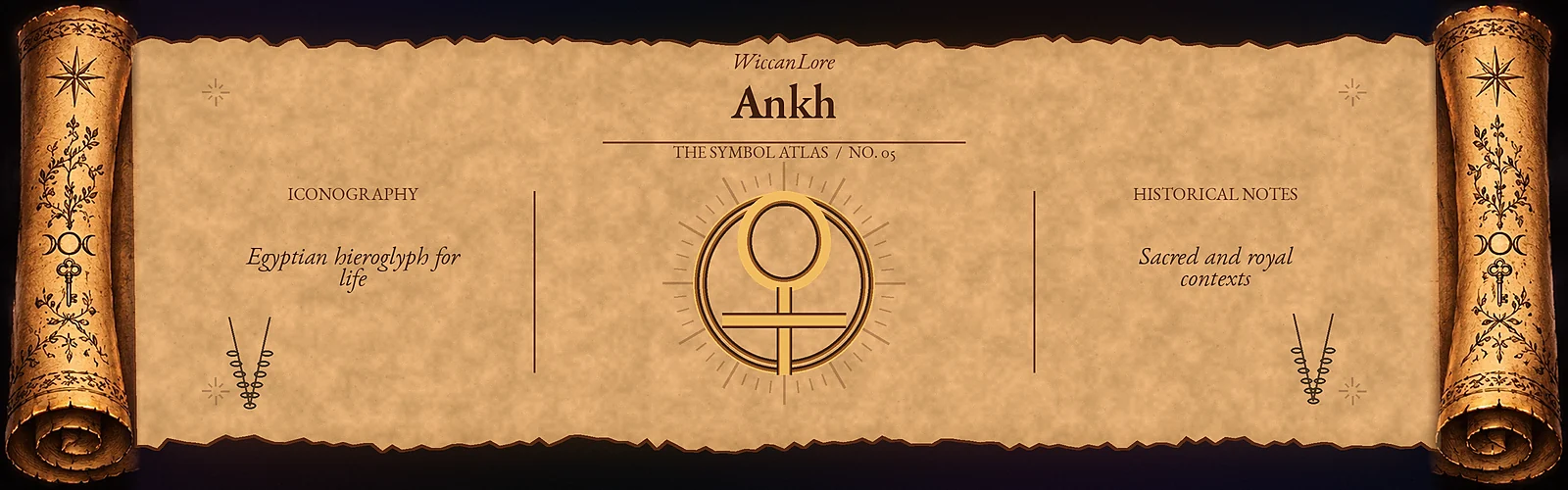
THE SYMBOL ATLAS · No. 05 · Expanded reference edition
Look at an ankh and you may see a cross with a loop for a handle. Ancient Egyptians could see a word, a wish, a divine gift, a piece of ritual equipment, and a remarkably adaptable graphic design. The most reliable starting point is also the least mysterious: the ankh means “life.” In Egyptian writing the sign could help write “life,” “live,” and “alive.” That basic meaning is documented by museum collections, inscriptions and objects surviving across millennia. The argument begins when someone claims to know exactly what the loop originally depicted—or insists that every modern wearer must mean the same thing as a pharaoh.
This guide follows the evidence from early Egyptian carved stone through the royal tombs, a remarkable golden mirror case, Christian-era textiles and contemporary symbolism. Its governing distinction is simple: we know the Egyptian meaning far more securely than we know the sign’s original pictorial model.
At a glance: what is the ankh?
- Original context: Ancient Egypt; used in the Egyptian writing system and as a symbol in art and material culture.
- Egyptian word: conventionally transliterated ꜥnḫ or ankh, usually translated “life,” “to live,” or “alive.”
- Appearance: one vertical stem, a crossbar, and an oval or round loop above it; proportions and ornament vary.
- Writing function: a hieroglyphic sign; in modern Egyptological sign lists it is commonly identified as Gardiner S34.
- Symbolic contexts: life granted by deities, royal well-being, continued existence after death, and objects carrying wishes or invocations.
- Later adaptations: some Christian-Egyptian forms of the crux ansata, and diverse modern expressions of Egyptian heritage, spirituality, design and personal identity.
- Important uncertainty: whether the shape originally represented a sandal strap, bow, knot, another object, or a visual form no longer identifiable.
What does “ankh” mean? Language before legend
Ankh is not an English acronym or a modern spiritual slogan. It is a conventional rendering of an ancient Egyptian word represented in Egyptological transliteration as ꜥnḫ. Egyptian writing systems typically recorded consonantal information far more explicitly than vowels, so the familiar English pronunciation “ank” (often said like “ankh,” with an ordinary final k sound) is a modern convention, not an audio recording of a person speaking in Old Kingdom Memphis. University College London’s Digital Egypt overview of the Egyptian language explains why reconstruction of earlier vowels remains uncertain.
It is worth separating three things: the word for life; the hieroglyph used to write that word; and the image of an ankh being held, displayed or manufactured. On an inscribed object, the sign can do linguistic work. On a wall relief, a deity can physically offer it to a king. On a small pendant, it can become a wearable expression of an idea. Those contexts overlap, but they are not identical.
In translations of Egyptian royal formulae, you may encounter a wish such as “given life” or “given life forever.” The ankh belongs to that wider grammar of kingship and blessing, not merely to a visual dictionary of single isolated icons. For readers who want to investigate real words rather than internet guesswork, the Thesaurus Linguae Aegyptiae is a specialist research corpus of Egyptian texts and vocabulary. It is not a shortcut to a universal interpretation of every object, but it shows the kind of linguistic evidence scholars actually work with.
How far back does the ankh go? A securely dated early object
One of the most useful places to begin is the Metropolitan Museum of Art’s early dynastic libation dish, accession 19.2.16, dated approximately 3100–2900 BCE, Dynasty 1. Its greywacke stone form combines bent arms, read as ka, with a looped ankh sign. The Met explains that the combination can be read as a wish for life to the spirit—or possibly as the personal name Ankh-ka. The dish could hold a purifying liquid. It is a rare example of writing, sculptural design and ritual context coming together in one object.
This is a secure example from the very early dynastic period, not a reason to declare, with false precision, that someone invented the symbol in a particular year. Archaeological survivals are uneven; earlier, perishable or less recognizable examples may have disappeared. What matters is the dated artifact, its museum identification and the alternatives proposed by its curators. A claimed date without an object and context deserves more skepticism.
The dish also corrects a modern habit of separating “art,” “language,” and “religion” into tidy boxes. To its makers, those categories could occupy the same piece of worked stone. The sign was legible, meaningful and physically present.
A short timeline: the ankh across several worlds
| Period | Evidence and development | What it shows |
|---|---|---|
| Early Dynastic, c. 3100–2900 BCE | Met greywacke libation dish with ka arms and ankh, accession 19.2.16. | The sign already operates within writing and ritual design. |
| Middle Kingdom, c. 1981–1802 BCE | Wooden model ankh excavated at Meir, accession 12.182.66. | The sign can exist as a three-dimensional form, not only as writing on a wall. |
| New Kingdom, c. 1396–1386 BCE | Faience ankhs from Thutmose IV’s tomb and royal imagery preserved at the Met. | Life symbolism is incorporated into kingship, burial assemblages and court objects. |
| 18th Dynasty / Amarna | Images in which the Aten’s rays end in small hands presenting ankhs. | The life-giving theme can be adapted within a very specific royal religious program. |
| Late 18th Dynasty, Tutankhamun | Gilded wooden mirror case shaped as an ankh, Egyptian Museum Cairo, JE 62349. | The sign’s visual language moves into luxurious personal objects. |
| Christian Egypt, late antiquity | Looped-cross forms appear in textiles and other objects in Christian contexts. | An old form can acquire new associations without making all periods identical. |
| Modern centuries | New uses in heritage, diaspora, jewelry, religion, popular culture and design. | Meaning continues to be made by communities and individuals. |
Dates refer to specific surviving evidence or broad historical periods; they should not be mistaken for the first or only use in an entire civilization.
What did an Egyptian deity do with an ankh?
In temple and court scenes, a god or goddess frequently holds an ankh, or offers one to the ruler. Because the sign means life, the action can be understood as granting or sustaining life. The scene is a representation of a relationship: the king receives what divine power bestows. The important detail is not that a supernatural object can be purchased or activated, but that a visible sign becomes part of the narrative grammar of royal authority.
A superb case is the arm panel from a ceremonial chair of Thutmose IV. On one side, an animated ankh offers the king the breath of life. On the other, divine figures appear with inscriptions promising life and enduring royal well-being. The museum’s object record lets us see the ankh working inside a larger composition—together with royal names, divine beings, protective gestures and ceremonial furniture.
In Amarna-period imagery, the sun disk Aten’s rays can terminate in hands that hold ankhs before the royal family. The image has a particular theological and political setting; it should not be flattened into a timeless “sun worship plus life force” infographic. The Global Egyptian Museum’s ankh glossary specifically describes this distinctive pictorial arrangement.
The ankh and the dead: life in the tomb is not a contradiction
If ankh means life, why is it found in funerary settings? Because ancient Egyptian ideas of continued existence did not require a neat split between “life” and “afterlife” as modern everyday language sometimes does. Tombs and funerary objects repeatedly speak to renewal, endurance, identity and the hope of continued being. The ankh could express the life that its owners desired, now and beyond death.
In the tomb of Thutmose IV (KV 43), excavated by the Davis/Carter team in 1903, archaeologists found faience implements made in the shape of the sign. The Met now catalogs one as accession 30.8.30, approximately 1396–1386 BCE. It measures 20.8 cm high and bears a cartouche with the king’s name in its center. That makes it something more specific than “a good luck charm”: it is a dated, excavated object from a royal burial and one that we can identify by material, place, ruler and inventory number.
Ancient people could understand amulets, words, images and ritual acts as consequential. A modern historical explanation should report those beliefs precisely, rather than asserting that an object is demonstrably capable of prolonging life or preventing harm.
Ankh, djed and was: three signs that belong together
Egyptian art often brings several hieroglyphic signs into the same design. The ankh invokes life; the djed pillar is associated with stability or endurance; the was staff commonly signifies dominion or authority. Their combination could form a compact visual statement about a ruler or divinity. The Met’s faience-and-gilding amulet with ankh, djed and was above a neb basket is a useful surviving example.
Each sign has its own history. The Met’s discussion of the djed pillar traces its longstanding association with permanence and its later close association with Osiris. The Eye of Horus, by comparison, belongs to stories of an eye injured and restored. Their themes can overlap with healing or renewed life, but no symbol should be described as interchangeable with another merely because modern shops place them together on pendants.
The broader lesson is grammatical. Images can form combinations, not just individual labels. Reading them responsibly means asking what these particular signs together are doing in this particular object.
What shape was the ankh originally supposed to depict?
This is one of the great temptations of symbol history: the meaning is so clear that people assume the outline must have an equally clear origin. It does not. The ankh is often represented as a loop over a horizontal crossbar with a long vertical stem, but specialists have debated the everyday physical model behind that outline for more than a century.
The sandal-strap hypothesis
The Egyptologist Alan Gardiner proposed an interpretation relating the sign to a sandal strap or thong. The loop and crossing pieces might reflect how a strap fitted around a foot. Museum introductions still discuss this possibility. The difficulty is the direct evidence connecting a specific ancient object and the hieroglyph’s development: the hypothesis is influential, not a historical photograph of the original invention.
Bows, knots and other proposed forms
Other proposals include an elaborate bow or knot, articles of dress, and different anatomical or natural forms. A scholarly discussion of Egyptian visual symbolism by a study in Religions (2018) reviews several competing suggestions, including the sandal strap, and notes the absence of consensus. That disagreement is not an invitation to declare that all explanations are equally well supported; it is a reason to distinguish hypotheses from inscriptional facts.
What about the sun, male and female anatomy, or a cosmic key?
Contemporary diagrams sometimes label the loop “female,” the shaft “male,” and the crossbar “horizon”; other posts declare that it represents the sunrise or an occult union of opposites. Such interpretations may be meaningful to modern users, but a visual resemblance is not proof of an original Egyptian designer’s intention. Likewise, “key of life” is a popular later nickname, not evidence that the sign literally began as a key for a physical lock.
There is no shame in saying “we do not know.” This is one of the places where a specialist becomes more interesting than a motivational poster.
Was it always a religious emblem? Writing, objects and visual puns
The ankh’s history is more flexible than the modern category “religious symbol” suggests. Inscriptions could use it to communicate language. Court artists could stage a god handing it to a king. Craftspeople could turn it into objects. It could be carved, glazed, painted, worn and combined with other signs. Its religious significance is real; so is its practical place in a complex writing and design culture.
A particularly beautiful example is Tutankhamun’s ankh-shaped mirror case, inventory JE 62349, now in Cairo. It is made of gilded wood with inlaid decoration and the king’s name. The actual mirror was not recovered from inside it. An ankh-shaped container holding a reflective object is a reminder that Egyptian makers enjoyed working with the meeting point between a recognizable sign and an everyday thing. It need not be flattened into either “pure magic” or “pure decoration.”
It also explains why modern jewelry and product designers keep returning to the image: the outline is legible from a distance, yet elastic enough to be made in many materials and levels of detail. That aesthetic durability is part of the story, not a substitute for the historical record.
Egyptian religious continuity and the Christian crux ansata
As religious life in Egypt changed in late antiquity, some looped-cross forms appeared in Christian visual culture. The Latin phrase crux ansata means “cross with a handle” or “handled cross.” It is a label used for this shape; it should not be confused with the Egyptian origin of the word ankh.
We can move past general claims of “the Coptic Church adopted the symbol” by examining a particular object. The Institute for the Study of the Ancient World’s exhibition record describes a fifth- to sixth-century Egyptian furnishing fragment, held by Dumbarton Oaks, in which a cross also functions visually as an ankh. Flowers and baskets surround it. Another documented ansate-cross textile in the Mariemont collection is dated to roughly the third through fifth centuries and discusses Christian reinterpretation of the life sign.
Such objects show change across centuries, materials and worshipping communities. They do not mean that every Christian cross is secretly an ankh or that a modern Coptic Christian and an ancient Egyptian priest understood the same symbol in exactly the same way. A shared form can carry meaningful continuity while its interpretation shifts.
Modern meanings: heritage, religious life, fashion and personal choices
The ankh now appears in jewelry, tattoos, music, art, visual identity and contemporary spiritual practice. Some wearers connect it with Egyptian antiquity and African or African-diasporic cultural heritage. Others use it to signify life, mortality, continuity, personal resilience or an affiliation with a spiritual tradition. Many simply appreciate the design. These are not interchangeable histories, nor does an observer get to infer a person’s beliefs from a pendant.
It is especially important to avoid turning Egyptian history into generic interchangeable “ancient wisdom.” Egypt’s own ancient language and material record deserve to stand on their terms; modern people also deserve to define what their adopted symbols mean to them. An article can respect both without pretending that the modern interpretation is a verbatim three-thousand-year-old teaching.
As a visual artist, one can notice the ankh’s exquisite balance: a strict central axis, horizontal arms, a long stem, and the soft counterform of the loop. That formal clarity explains its strength as a motif. As a historian, one must add the missing question: who used this particular version, in what setting, and when? The finest reading keeps the shape and its human contexts in view simultaneously.
Common claims: what the evidence actually supports
| Claim | Historically responsible answer |
|---|---|
| “The ankh means life.” | Yes. Egyptian usage and museum records firmly support that basic reading. |
| “It was invented as a key to the Nile.” | Popular modern nickname and symbolism; not a demonstrated original design function. |
| “It definitely represents a sandal strap.” | Influential scholarly hypothesis, not a settled fact. |
| “All ankhs are fertility symbols.” | Overgeneralization; meanings and uses depend on documented context. |
| “The ankh is the same as the Christian cross.” | Some forms were adapted and reinterpreted in Christian Egypt; traditions remain distinct. |
| “Wearing it protects a person from harm.” | People have associated amulets with well-being and protection; supernatural effects are not established historical or scientific facts. |
| “No one knows anything about its origins.” | Too strong: the sign is documented from early Egypt; its specific pictorial prototype remains debated. |
Field guide: how to examine a real ankh object
- Start with provenance: museum accession number, excavation location, dating and material. A seller’s caption is not the same as an excavated object record.
- Describe the shape: open or closed loop, crossbar width, stem length, surrounding signs, ornament and mounting.
- Ask what kind of object it is: hieroglyph within writing, temple relief, votive object, furniture part, tomb find, amulet or modern art.
- Read its neighbors: deity, king, cartouche, djed, was or other signs may change the meaning of the composition.
- Date its interpretation: a twentieth-century esoteric explanation is not automatically an Old Kingdom Egyptian one.
- Keep unknowns visible: uncertain origin, ambiguous readings and incomplete provenance are part of the answer.
Frequently asked questions
Is the ankh older than Christianity?
Yes, by several millennia. The Met catalogs ankh imagery on an object from around 3100–2900 BCE. Christian Egyptian looped-cross examples belong to much later historical contexts.
Is an ankh a type of hieroglyph or an amulet?
Both, depending on context. It functioned in writing and was also manufactured as an object or incorporated into figurative art.
How do you pronounce the original Egyptian word?
“Ankh” is the established modern spelling, but the precise vowel sounds of early Egyptian speech are not fully recoverable from hieroglyphic writing. Treat modern pronunciations as conventions.
Is a circle around the ankh required?
No. The classic ankh already includes a loop at the top; later decorative circles, borders and ornament are not a universal original feature.
What is the difference between an ankh and the Eye of Horus?
The ankh signifies life; the wedjat or Eye of Horus is connected to the myth of an injured and restored eye and to protection or renewal. See The Symbol Atlas: Eye of Horus for its distinct story.
Glossary: five terms worth keeping
- ꜥnḫ / ankh
- Conventional scholarly transliteration and familiar English spelling of the Egyptian life word and its visual sign.
- Hieroglyph
- One of the signs used in ancient Egyptian writing; signs can carry sound values and other linguistic functions.
- Ka
- An important Egyptian concept relating to a person’s life force or vital existence; also represented in writing by bent arms, as on the early Met dish.
- Djed
- Pillar-shaped sign associated with stability and permanence.
- Crux ansata
- Latin description of a cross with a handle or loop, used in scholarship on certain Egyptian and Christian Egyptian forms.
Sources, objects and further study
The links below lead to collection records or documented research rather than unattributed symbol charts. Together they let readers check chronology, materials, original settings and areas of continuing disagreement.
- The Metropolitan Museum of Art, “Libation Dish Depicting Ka-Arms Presenting an Ankh-Sign” (Dynasty 1; accession 19.2.16). Essential early evidence; includes a nuanced alternative reading of the arrangement.
- The Met, “Model ankh” (Dynasty 12; accession 12.182.66). A documented Middle Kingdom three-dimensional example.
- The Met, “Ceremonial Implement in the Shape of an Ankh” (Thutmose IV; accession 30.8.30). A dated royal tomb object, with excavated context.
- The Met, “Arm Panel from a Ceremonial Chair of Thutmose IV”. An excellent guide to how an ankh communicates life inside a royal image.
- The Met, “Ankh, djed, was on neb basket”. A material example of signs working as an ensemble.
- Global Egyptian Museum, “Mirror Case in the Form of an Ankh, or Life Sign” (Cairo JE 62349). Tutankhamun’s mirror case and its physical materials.
- Global Egyptian Museum, “Ankh”. A concise museum treatment of the meaning and contested iconographic origin.
- UCL Digital Egypt, “Language and Sound”. Background for the limitations of reconstructed ancient pronunciation.
- Thesaurus Linguae Aegyptiae. Specialist lexicon and text corpus for further linguistic research.
- Religions (2018), study of Egyptian lotus symbolism and ritual imagery. Includes a literature-based discussion of disputed ankh-origin hypotheses.
- NYU Institute for the Study of the Ancient World, Christian-Egyptian furnishing fragment (5th–6th century). Material evidence for later recontextualization.
- Collection of Coptic Textiles, “Pile ansate cross”. A cataloged textile illustrating later use of the looped-cross design.
About The Symbol Atlas: WiccanLore investigates symbols as historical objects and living cultural forms: what they looked like, where they were used, what people believed they meant, and which attractive modern claims survive contact with evidence. To continue exploring, read the Pentacle, the Triquetra, and the Ouroboros.