


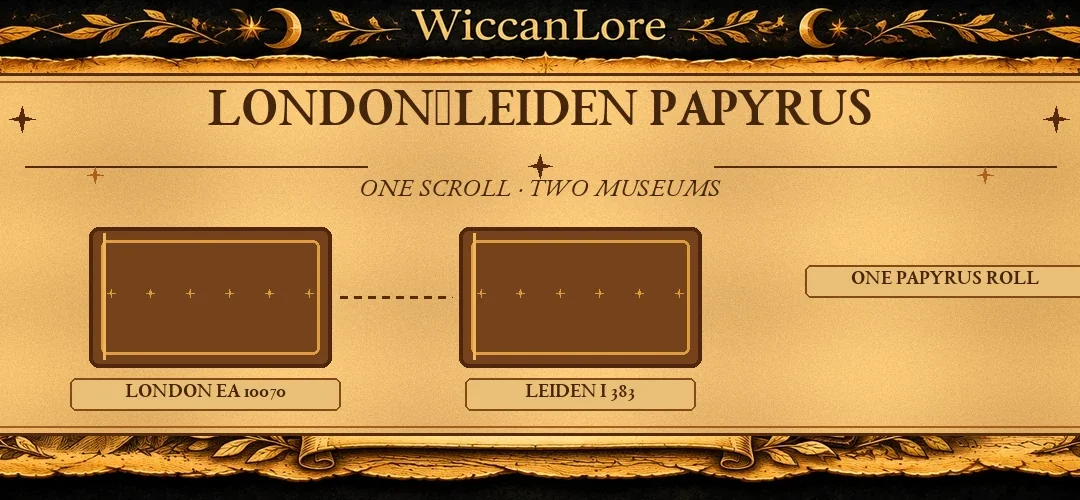
The London–Leiden Magical Papyrus is an ancient Egyptian ritual-text manuscript now divided between collections in London and Leiden. Its surviving Demotic and Greek material is catalogued as PDM/PGM XIV (GEMF 16). Those parts belong to one historical manuscript, but they should not be confused with Leiden I 384 (GEMF 15) or the Great Paris Magical Codex (PGM IV).
The Living Grimoire
One manuscript, two museums, one broken edge
The first surprise of the London–Leiden Demotic Magical Papyrus is not a spell. It is a join.
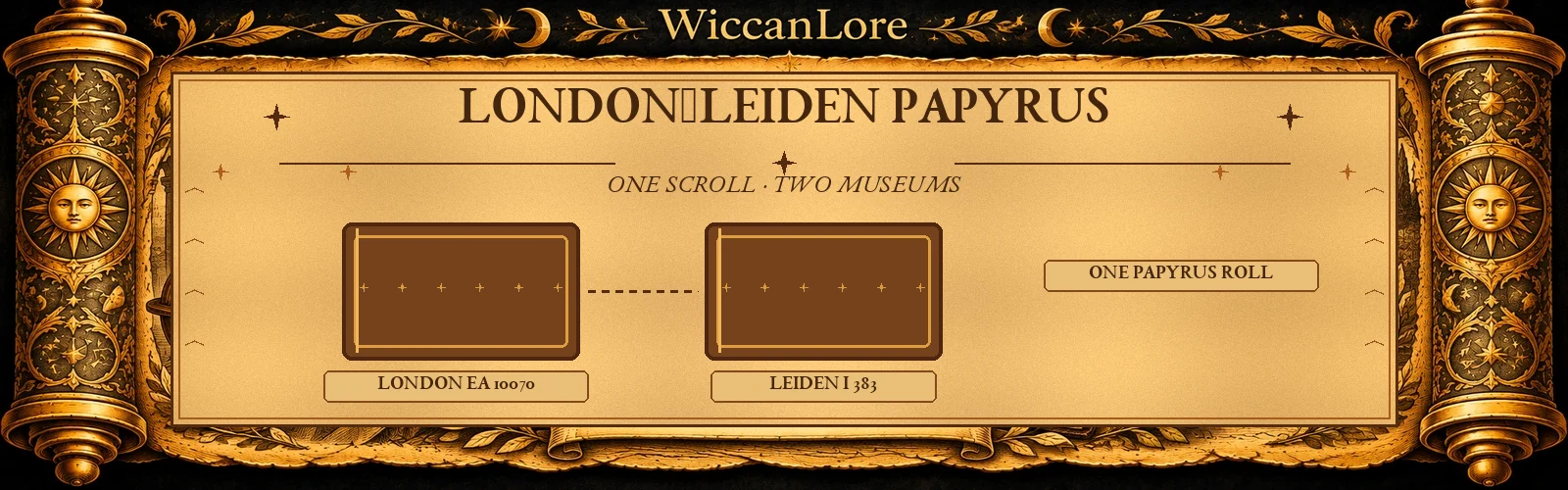
A manuscript in the British Museum, numbered EA 10070, and another in the Rijksmuseum van Oudheden at Leiden, numbered Papyrus I 383, were once parts of one ancient Egyptian roll. At the end of London’s portion, a column of writing continues into Leiden’s first column. The break belongs to the object’s modern history, not to an ancient author’s decision to divide the work into chapters. These separate shelfmarks make perfect sense for two collections; they can be deeply misleading if we read them as the titles of two independent books. [1] [2] [3] [4]
Imagine that you had two halves of a family letter and only later realized the sentence cut off at the edge of one half resumed on the other. You could learn something that neither fragment disclosed alone. For this papyrus, the stakes are much larger than deciphering a private message. The joined portions preserve a remarkably extensive body of Roman Egyptian ritual writing: a roll of roughly five metres, with writing arranged in twenty-nine recto columns and additional columns of more irregular text on the verso. Its physical layout is evidence about how material was organized, consulted and copied. It does not tell us the name or biography of the particular scribe. [1] [4]
What a remarkable linguistic neighborhood this roll preserves. Demotic Egyptian predominates, but Greek words and passages share the papyrus with Old Coptic and occasional hieratic forms. Each has its own linguistic or scribal history. Call the whole object a Greek magical papyrus and much of its Egyptian identity disappears; call it simply a book of ancient spells and the distinctive world of its writers vanishes behind a rather unhelpful label. [1] [2] [5]
The concerns of its writers range from divination and encounters with the divine to illness, love and conflict. There is a certain intimacy in discovering that ancient people addressed the sacred with such familiar human anxieties. Those of us drawn to magic may recognize the impulse. We should also give Roman Egyptian religious and scribal practices the dignity of their own history, rather than retrofitting them into a modern Wiccan Book of Shadows.
A small warning for the bibliographically adventurous: Leiden I 384 is another manuscript, not a lost section of this roll. The substantial Paris PGM IV / GEMF 57 is a separate codex, too. The objects belong to related fields of study, which makes their differences worth understanding. A shelfmark is sometimes the simplest charm against an invented history.
A single ancient scroll now lives in two cities. Follow the join, then follow the words. The geography of its survival is already a compelling story.
Why the number 383 matters
There is a deceptively important cataloguing trap here. The Leiden half of the London–Leiden roll is I 383, not I 384. The museum also holds Leiden I 384, a different ancient manuscript with Demotic and Greek ritual writings. In modern scholarship, that separate manuscript is called PGM/PDM XII or GEMF 15, while the reunited London–Leiden roll is PGM/PDM XIV or GEMF 16. [1] [6]
This is more than a correction for librarians. The two objects have related content and may share a copying milieu. Scholars have even proposed a connection between their scribal hands. That resemblance encourages accidental conflation.
But related manuscripts are not the same physical manuscript. A digital Atlas that uses Leiden I 384 as the Leiden portion of PDM XIV would create a false museum identity, connect the wrong historical images, and misattribute Greek text to the wrong roll.
The first-page lesson of this chapter is therefore unusually practical: reliable history begins with the right shelfmark. Once the objects are properly separated, the relationships among them become more fascinating, not less.
A papyrus that could speak more than one language
The roll’s dominant language is Egyptian, recorded largely in the Demotic script. This was a living written form of the ancient Egyptian language used widely in later periods. But the scribe also used Greek and forms of Egyptian notation in Old Coptic letters, and drew on the older hieratic tradition. [1] [5] [7]
These writing systems did not all mean the same thing. A Greek gloss might help a reader pronounce an Egyptian expression. An Old Coptic representation might capture sounds not easily conveyed in a particular Demotic spelling. A more opaque sign sequence might mark a name or a deliberately difficult expression.
The script mix is sometimes so complex that scholars use the term cipher writing. The book did not simply contain a code invented to hide information from enemies. It belongs to a culture where highly trained writers could make script itself carry meaning and authority.
The historian Jacco Dieleman devoted a major 2005 monograph to the London–Leiden manuscripts and to the implications of their multiple scripts. He argued that this combination offers evidence of an Egyptian priestly educational environment, while recognizing that identifying one scribe’s exact individual status remains more difficult. [5] [8]
More recent scholarship has refined the picture. A 2025 study of bilingual scribes compares this roll with Leiden I 384 and other formularies. Paolo Milizia, in a paper appearing in the journal’s 2025 volume and published online on 7 January 2026, argues that the cipher script was a consciously shaped cultural artifact, including what he describes as Greek letters made to look Demotic. [7] [9]
This is an exciting change in emphasis. A difficult-to-read line is not only a problem for translators. It may reveal how a writer thought about belonging to Egyptian traditions while living in a Greek-speaking imperial world.
A priestly library—or a more complicated history?
The papyrus is often associated with the so-called Theban Magical Library, a proposed group of manuscripts from the region of Thebes in Upper Egypt. The collection includes Greek and Egyptian ritual texts that passed through the antiquities dealings of Giovanni d’Anastasi. [1] [10]
But “Theban Magical Library” is a modern scholarly reconstruction. We lack a secure archaeological report showing a single ancient room in which every associated manuscript lay on a shelf. The find contexts were poorly recorded during nineteenth-century collecting, and some objects may have been gathered from different sources.
A museum exhibit can responsibly say associated with the Theban region; it should not invent the precise tomb, priestly owner or excavation scene.
The papyrus’s modern journey is unusually clear in comparison. The Leiden portion was sold to the Dutch government in 1828, with some individual museum panel records giving January 1829 as an acquisition date. The London portion was purchased in connection with an 1857 Paris auction of Anastasi’s antiquities. [1] [2] [4]
That is how two parts of one ancient roll ended up in different national collections. Its story includes both ancient scribal skill and the disruptive effects of the nineteenth-century antiquities trade.
The gods who appear in the lamp and bowl
Many entries are concerned with divination. A writer imagines receiving answers through a lamp, a vessel or bowl, dreams, the moon or the sun. These acts are often described as occasions for divine appearance or inquiry. [1]
The names in the papyrus belong substantially to Egyptian religion, including Osiris, Khonsu, Imhotep and the divine solar barque. Other passages combine them with Greek expressions or names of broader Mediterranean significance.
This is not evidence that an ancient Egyptian scribe belonged to a modern universal occult lodge. It is evidence that a person or group within Roman Egypt drew on religious and intellectual materials available in that environment.
A lamp in this book is more than a light source: in the narrated worldview, it can become a focus of divine encounter. A bowl of liquid becomes a place where knowledge might be sought. These ideas matter historically even if the claimed supernatural results are not scientifically verified.
An educational article can explore the symbolism of light, water, night and divine response without reproducing any hazardous ingredients, manipulative directions or promises of successful divination.
A different kind of completeness
The roll is enormous, but it is not necessarily intact. Early editors note that its first surviving column is damaged, so it is uncertain whether the original book began there. The Leiden end is also broken, with indications that additional writing once followed. [4]
This is a paradox of manuscript history. An object may preserve thousands of lines and still lack both its beginning and end. We should resist the temptation to call it “the complete original Egyptian Book of Magic”.
The contents themselves are varied. The front is laid out in large framed columns; the back carries many shorter entries more irregularly, suggesting supplementary notes, later use or different kinds of textual organization. Those possibilities require manuscript-specific study and should not be turned into an invented history of one priest adding recipes at home every evening.
The papyrus has an important modern edition, and the new 2022 GEMF 16 scholarly presentation offers detailed text and translation. Yet both editions involve interpretive choices, especially where the surface is damaged or an ancient word can be read in multiple ways. [4] [11]
The strongest question we can ask is not “Which modern book contains all the authentic secrets?” It is how does this specific surviving ancient object allow us to see people thinking with writing?
The Deep Archive
1. The exact work identity
The conventional London–Leiden Demotic Magical Papyrus is a physical papyrus roll split between British Museum EA 10070 and Rijksmuseum van Oudheden Leiden I 383. Its modern identifiers include PDM xiv, PGM XIV, GEMF 16, Kyprianos M162 and Trismegistos 55955. [1] [2] [3]
One can acquire quite a collection of names for the same papyrus without acquiring any additional papyrus. PGM/PDM and GEMF belong to modern editorial cataloguing systems; the museum inventory numbers locate the surviving pieces. The labels multiply, but the physical evidence does not.
A single ancient roll can therefore have two present custodians. The two institutions hold portions of the same original roll, a material relationship supported by the writing across the tenth column.
This differs from the Great Paris Magical Codex, BnF Supplément grec 574 = PGM IV = GEMF 57, an actual fourth-century papyrus codex in Paris. Similar provenance traditions and languages do not make them one physical book.
2. The major correction: I 383 is not I 384
The University of Würzburg’s Kyprianos M162 entry explicitly states “P. Leiden I 383 + P. BM EA 10070.” The Rijksmuseum van Oudheden’s own first-party page for I 383 describes its continuation from the London manuscript. [1] [2]
By contrast, Kyprianos M160 identifies Leiden I 384 = PGM/PDM XII = GEMF 15. I 384 is another bilingual roll, with a distinctive earlier Egyptian literary text and ritual writing on the opposite side. [6]
The numbers differ by only one digit, and the manuscripts are often discussed together. This makes them an ideal trap for a generalized search model or automatic scholarly bibliography.
Any older earlier research plan that says the split London–Leiden physical manuscript equals BM EA 10070 + Leiden I 384 is incorrect and must be replaced with BM EA 10070 + Leiden I 383.
This is a confirmed correction, not an interpretive debate about dating.
3. The two national collections
The British Museum holds the London portion as EA 10070; the museum’s 2022 Hieroglyphs: Unlocking Ancient Egypt exhibition guide explicitly presents a section as EA 10070,2. [3]
The Rijksmuseum van Oudheden holds the continuation Papyrus I 383, previously Anastasi/AMS 65. Its public panel 5 record concerns recto XXII–XXVI only and has specific glass-mount measurements, black/red ink and Demotic/Greek alternation. The whole Leiden fragment begins in the end of shared recto X, continues through XXIX and includes verso I–XXIV, according to GEMF 2022. Panel 5 ≠ whole Leiden scroll and must not be treated as proof that the Leiden portion begins at XXII. [2] [11]
The London portion’s earlier Anastasi number was 1072. The two former collector numbers document separate pieces in modern possession, not two independently composed ancient texts.
London and Leiden are the two modern homes of this object. The distance between them is less remarkable than the evidence that bridges it: the ancient writing itself continues across the join. A sentence can have a longer and stranger journey than any map of museum locations suggests.
The modern collection locations identify the surviving portions; their original physical relationship explains why they are studied together.
The join has a fully grounded recto/verso concordance: BM EA 10070 = recto I–X (partial X), verso XXV–XXXIII; Leiden I 383 = recto other part of X–XXIX, verso I–XXIV. The single split column X is the physical join reported by the nineteenth-century editors and confirmed by RMO’s present holding page. A modern graphic should represent 29 unique recto columns and 33 verso units, while keeping Leiden’s panel-based mounted subsets distinct from ancient foliation. [1] [2] [4] [11]
Even the Leiden registration is panel-specific. The RMO’s modern first-party listing for AMS 65, sheet/panel 5 covers recto XXII–XXVI and six verso columns. It describes the ancient papyrus itself as 24.3 × 60.5 cm, mounted between glass measuring 28 × 65 cm, with modern papier végétal interleaving/adhesive support. These dimensions are one surviving museum panel and its glass mount, not the complete 5-metre original roll. The old AMS 65 and present Leiden I 383 designations should be connected to the same collection part, but not used as generic labels for every separately mounted sheet. [2]
4. The ancient date is approximate—and sources differ
Würzburg’s Kyprianos M162 record gives 101–250 CE, with Quack’s narrower 151–250 CE recorded in its date notes. The 2022 GEMF 16 critical edition (printed p.135) explicitly dates the physical book-roll “late II CE”; the British Museum’s 2022 guide labels its London portion AD 200–300 and RMO’s Leiden panel likewise Roman 200–300 CE. These are competing physical dating assessments for the same manuscript, not dates of separate rolls or proof of a specific writing year. Kyprianos also preserves a previously listed 201–226 CE BM website assessment. [1] [2] [3] [11]
These estimates are not identical. They reflect different institutional conventions and scholarly dating methods. They overlap in the first half of the third century, a useful approximate working period.
The responsible wording is late second or early third century, with a defensible source-specific range rather than a precise year. GEMF 2022 favors late second, while current museum labels favor third century. No physical colophon resolves the difference. [1] [2] [3] [11]
There is no secure dated ancient colophon giving the day, month and year the entire roll was written.
The date of the underlying formulae may also differ from the date of the surviving copy. A scribe can copy older text, change it, annotate it or place it beside newer material.
5. A five-metre book-roll
The surviving joined roll is roughly five metres long and 24–25 cm high. Griffith and Thompson’s 1904 original printed page 4 reads “5 m. (about 16½ feet)”. Searchable PDF text misreads its half-foot symbol as “168 feet”; direct image inspection confirms the original editors did not print a 168-foot measurement. The 1904 editors and 2022 GEMF 16 p.135 agree on 29 recto and 33 short verso columns (62 column units). A 2025 article’s “xi–xxxix” for later recto drafting conflicts with the 29-column object count and may be a sectional typographical error; until the authors clarify, do not generate a 39-column alternative manuscript from that phrase. [1] [4] [7] [11] [16]
The front and back are organized differently. Recto columns are large and often ruled or framed; verso entries are shorter, sometimes separated and added in a less continuous layout.
That is evidence of a book-roll, not a codex with numbered pages. A modern reader who cites “page 15” without an edition may be referencing a modern printed book rather than the ancient surface.
For digital display, one can create a reconstructed horizontal roll chart with the British Museum part aligned before the Leiden continuation. Such a diagram should distinguish the ancient material from modern museum mounting and any missing portions.
The material condition changes what scholars can know. In their original 1904 introduction, Griffith and Thompson describe the British Museum segment as pale papyrus with strong, dark, mostly legible ink. They explain that Leemans had placed a protective vegetable-paper layer on both sides of the Leiden segment; over time it darkened or otherwise reduced legibility in places. Reuvens made a tracing of the Leiden material in 1829 before that treatment, which the editors used when letters were no longer clear. [4] [16]
Thus a modern reading can rest on different grades of source evidence: an extant papyrus surface, a nineteenth-century tracing of that surface, an early editor’s lithographic facsimile, or an inferred restoration of damaged words. A digital edition should annotate those grades, rather than treat every normalized printed glyph as equally visible on the present object. This also explains why the order of acquisition, early tracing, and conservation matter to philology as well as museum history.
6. The continuous tenth column
The defining join is clear in the historic critical edition by Francis Llewellyn Griffith and Herbert Thompson. They report that the tenth and final recto column of the London fragment and the first Leiden fragment form one continuous column. [4]
This is a particularly strong relationship because it is based on textual and physical continuity, not simply shared themes.
A scholar can therefore reconstruct the original reading order across the museum split. The identification was recognized in the nineteenth century, and later critical editions published the combined text.
The break is not a mark deliberately drawn by an ancient author. It is damage and later collection history.
The 2022 GEMF 16 introduction gives London recto I–X / verso XXV–XXXIII and Leiden recto the continuation of X–XXIX / verso I–XXIV. The split recto X is counted once in the full roll, despite existing in both museum fragments. Museum glass-panel identifiers represent later conservation, not original numbered chapters. Any reconstructed visual seam requires both original scanned edges, a separately documented image licence from each museum and a verified match; no such image files or permissions were obtained here. [2] [4] [11]
7. A damaged beginning and an absent end
The first London column is incomplete. Griffith and Thompson (1904) say it might have been the original start, but a prior loss is possible; they interpret the Leiden’s broken terminal edge as traces of a further column. The 2022 GEMF 16 editors summarize both original ends as lost, while explicitly reporting Dosoo’s alternative hypothesis that no additional whole columns may be missing. The difference concerns how many units were lost, not the physically continuous shared column X. Retain uncertain original beginning, damaged ending and unknown number of lost complete columns; an imagined complete opening or ending cannot be drawn as attested papyrus. [4] [11] [16]
For all the magnificent extent of the surviving material, the roll still keeps some of its secrets. Its original full length and complete final contents remain unknown. The abundance of what has survived is worth celebrating without pretending that the papyrus has reached us intact.
This also means that any proposed first title and last colophon need scrutiny: the original may not have supplied the same boundaries as the modern edition.
A responsible article can celebrate the size of the manuscript while acknowledging what is missing.
8. What the Leiden museum physically records
The Rijksmuseum van Oudheden’s object entries are unusually informative about ink, scripts and panel divisions. One I 383 record describes black and red ink, Demotic and Greek writing, Demotic read right-to-left, Greek read left-to-right, and Greek glosses within the Demotic columns. [2]
A panel also records that part of a line is written in Greek within an otherwise Demotic column. Other panels have separate line counts and marked headings.
The museum’s old numbering and individual glass panels are conservation and cataloguing units, not necessarily chapters in the ancient work.
The object record’s precision is valuable. It allows an editor to identify a real recto column XXIV, for example, instead of choosing an unlabeled photograph of “Egyptian papyrus” and attaching it to a random paragraph.
No current source image has been imported into WiccanLore by this article.
The first-party catalogue is specific enough to support a bilingual writing map. RMO’s panel-5 record documents recto column XXIII, lines 9–20, as Greek, while column XXIV has 39 lines and multiple red rubrication points. Its verso section includes Greek interspersed with Demotic, and even a short group rotated ninety degrees below verso columns I and II. These observations are tied to one modern mount and should never be extrapolated indiscriminately across every part of the roll. [2]
The same museum explicitly gives two opposite writing directions: Demotic runs right-to-left and Greek left-to-right. When reconstructing a digital transcription, Greek glosses must be anchored to the exact source words and line positions; an automatic “render all text left-to-right” pipeline could erase the linguistic evidence. [2]
9. Demotic is a language-writing relationship, not a magic alphabet
Demotic is a form of the ancient Egyptian language written in a cursive script that developed over many centuries. It was used for documentary, literary, religious and other materials.
The London–Leiden roll is called Demotic because that is its principal writing mode, not because Demotic itself is exclusively an occult alphabet.
A text written in Demotic can concern an ordinary contract; a ritual text can be written in Greek; and some late antique scribes used more than one script inside the same composition.
This distinction counters a modern visual cliché in which every unfamiliar Egyptian sign becomes a “secret magical sigil.” Historically, the script was an everyday learned writing tool with broad uses.
10. Old Coptic and how a sound became visible
Old Coptic refers to early attempts to write Egyptian using a largely Greek-derived alphabet, supplemented where needed by Egyptian signs. Some texts use these forms to record words and sounds in ways not always convenient in Demotic spelling. [3] [5]
In the London–Leiden roll, the coexistence of scripts reveals the scribe’s concern with pronunciation, transmission and representation. A ritual text may regard the sound of a name as important, which gives glosses a practical textual role.
It would be misleading to equate the appearance of Old Coptic script with a fully formed medieval Coptic Christian liturgy. This is Roman-period Egyptian language in a much earlier and more varied setting.
Modern editors need to decide when a word is written in Greek, Demotic, hieratic or Old Coptic-like characters; this requires source-language expertise, not a decorative font substitution.
11. Hieratic as a signal of training
Hieratic is an older cursive script historically associated with Egyptian scribal and priestly traditions. The roll’s use of hieratic signs alongside Demotic and Greek is a strong clue that the writer knew more than one Egyptian graphic register. [5] [8]
Dieleman studies this as evidence of an educated scribal environment. The skills involved go beyond the ability to repeat one popular charm by memory.
But it would still be too strong to announce a particular priest’s name or temple position based only on the script mix. The historical location, social networks and individual biography remain incompletely documented.
The right claim is that the educational milieu was highly specialized, consistent with priestly Egyptian scribal training.
A valuable 2025 qualification: Korshi Dosoo, Alberto Nodar and Panagiota Sarischouli argue that GEMF 15 (Leiden I 384) and GEMF 16 (the London–Leiden roll) likely shared one supervising scribe-user, who copied most or all extended Demotic passages and the short Greek glosses and in-line phrases. Their palaeographic comparison identifies three additional hands responsible for longer Greek sections across the two manuscripts. The authors also tentatively distinguish a possible second Demotic hand responsible for some headings inserted into blank spaces in Leiden I 384; that additional identification is less certain. [7]
This hypothesis is stronger and more specific than an unstructured assertion of “the same cultural atmosphere,” but still not an authenticated scribal signature or proof that both rolls were physically a single document. The authors propose an Egyptian temple-trained learned context based on the skills needed in Demotic, hieratic and Old Coptic, while acknowledging that the exact writer’s biography and the circumstances of each commission are unknown. The 2025 study proposes a shared supervising hand. That remains an attributed scholarly inference, not proof that the manuscripts had the same owner or a conclusively identified author.
12. A cipher alphabet that is more than secrecy
The roll contains passages using a special cipher-like script. Earlier research often emphasized concealment: difficult signs could prevent untrained people from reading certain ingredients or intended outcomes.
Dieleman analyzed the cipher and the ancient script mix, including words identifying ingredients and intended effects. Milizia’s actual 2025-volume/2026-online study quantifies 113 cipher-written word occurrences representing 93 distinct forms in the London–Leiden roll, and identifies one further cipher use in the separate Leiden I 384; these are word tokens and distinct word forms, not 113 distinct cipher signs. Its detailed analysis compares the 36-sign list in Griffith–Thompson’s edited alphabet with observed letter forms. These counts describe different aspects of the surviving writing and should not be conflated with a complete modern alphabet. [5] [8] [9]
Paolo Milizia’s study, published online in January 2026 in Ricerche Linguistiche, argues that the cipher includes Greek letters deliberately shaped to resemble Demotic forms and that its design is linked with cultural identity. His research challenges the idea that the cipher is simply a Greek alphabet plus a few borrowed Demotic characters. [9]
That argument changes the visual story. A scribe could use unusual writing both to regulate access and to express affiliation with Egyptian learned traditions within a bilingual world.
A subtle writing-direction issue matters for real visuals: Milizia notes that cipher words can run left-to-right inside predominantly right-to-left Demotic lines; their orientation can encode both writing convention and scribal cultural choice. The 113 tokens / 93 forms measure observed words, while 36 signs is the older editorial cipher inventory—three different data units. The direction of the inserted words cannot be inferred simply from the direction of the surrounding Demotic. Identifying the origins of the individual signs requires comparison with the original manuscript images. [9]
13. Bilingual scribes in 2025 research
A peer-reviewed study by Korshi Dosoo, Alberto Nodar and Panagiota Sarischouli, titled “Bilingual Scribes in Magical Formularies,” compares the London–Leiden roll (GEMF 16) with Leiden I 384 (GEMF 15) and other bilingual material. Its publication record is associated with 2025, with article numbering and online availability varying by source. [7]
The paper emphasizes that the surviving major handbooks use Greek and Demotic in different patterns. Some also use distinctive cipher writing, hieratic and other marks.
The authors consider not only what a script says but how it is deployed within a manuscript. Does one language dominate? Does another appear mainly as a gloss? Which words are left untranslated or given an unusual graphic form?
Such observations allow scholars to infer something about scribal training and intended readership, even without a signed autobiography.
The study provides an important comparative framework without making Leiden I 383 and I 384 one identical book.
The article offers a testable physical writing model for GEMF 16. It identifies the primary hand as M¹ and distinguishes M² and M³ in more extensive Greek passages of the London–Leiden roll. The Greek-writing examples cited are recto column IV, lines 9–19 (modern GEMF/PDM 101–111), column XV, lines 25–28 (452–455), and column XXIII, lines 9–20 (683–694). The different shapes, fluency and ligatures of these hands provide a physical basis for the attribution rather than a guess based only on language. [7]
The proposed sequence begins with a carefully planned first ten recto columns, characterized by framing and regular rubrication; the remaining recto text is proposed to have been developed in successive blocks, with additional shorter writing placed in blanks and on the verso. This is Dosoo’s staged-production reconstruction, discussed in the 2025 paper, not a dated ancient diary describing nine days of writing. It suggests that the main scribe-user could have expanded the collection during use, but the exact time between stages and the identity of invited scribes remain uncertain.
The three relevant long Greek extracts do not establish that every Greek word belonged to a foreign author; the principal scribe apparently could copy brief Greek expressions himself. Conversely, the fact that he knew Demotic does not make every longer Greek passage in GEMF 16 his own physical hand. The three proposed hand clusters are a scholarly reconstruction of the writing process, not three identified historical individuals.
14. The 2026 cipher study is not a new ancient discovery
Milizia’s paper is important because it develops an interpretive account of a long-known physical manuscript, not because a new papyrus was excavated in 2026. [9]
The manuscript was already known in the nineteenth century; scholars had published copies, studies and translations for over a century. The new argument concerns the shape and cultural meaning of the cipher signs, not the original discovery date.
This is how textual scholarship progresses. Material can be long familiar yet continue to offer new evidence when a reader asks different questions and looks carefully at difficult details.
A source archive should record research publication date, date of ancient artifact, and date of original identification of the London–Leiden join separately.
15. The first named topics on the roll
The Würzburg source inventory begins with several vessel inquiries, a description of a horoscope-casting associated with Imhotep, and an instruction concerning shadows. It then moves through further divination, lamp and vessel topics. [1]
This tells us something about editorial organization. The roll is not simply an alphabetical encyclopedia of every god or a continuous philosophical treatise.
One early item is identified as a vessel inquiry attributed to a physician from the Oxyrhynchus region. That named origin is a statement contained in the ancient text. It is not an authenticated surviving personal letter from a known physician.
A serious article can follow these item boundaries while avoiding the uncritical assumption that the person named in a recipe necessarily wrote the copy now held in London and Leiden.
16. Lamp inquiry: seeing by light
Several sections focus on a lamp as the center of inquiry. The source repeatedly uses headings that describe inquiries made by the lamp, words recited during such an inquiry, or encounters with a divine presence. [1]
The British Museum’s 2022 exhibition guide selected a passage about a lamp and a dream to explain the book’s importance to the history of decipherment and ritual writing. The museum labels the displayed part EA 10070,2, a real object reference. [3]
Light, shadow and night are compelling themes. In the manuscript’s worldview, a lamp is a medium of access to knowledge beyond ordinary perception.
But an explanatory article must distinguish the recorded ancient aspiration from evidence that the event took place. A copied text can describe a vision without proving that a spirit appeared.
17. Vessel inquiry: water and ritual authority
Other portions use a vessel or bowl, an approach modern scholarship may group under lecanomancy. A source heading invokes Khonsu in one extended vessel inquiry; another describes seeing the barque of the sun. [1]
These descriptions connect a material object, such as a bowl, to Egyptian conceptions of divine presence and cosmology.
A modern reader may see parallels with reflective practices or meditation. Such parallels can be explored as later comparative interpretations rather than proofs of an uninterrupted direct lineage.
The text’s procedures may include substances or circumstances that would not meet modern safety standards. This article intentionally discusses the historical category rather than providing an operational recipe.
18. Osiris, Khonsu and Imhotep are not interchangeable
The source inventory names Osiris, Khonsu, Imhotep and solar figures in different entries. These are historically distinct divine or cultic identities within Egyptian religion. [1]
A catch-all modern occult website might treat every name as “an Egyptian god of magic.” That loses the contextual and theological differences that the scribe and audience may have recognized.
The historian needs to look at the specific passage and invocation. An Imhotep-associated divination may draw on learned healing and wisdom traditions; a Khonsu-related inquiry has a different religious resonance.
An encyclopedia can link the names to separate source-led articles, but should not assign them all one identical domain or ritual “correspondence” merely to simplify product metadata.
19. The book’s view of healing
The roll contains entries classified by modern editors as healing or medical: injuries and bites, problems of the throat, bleeding, fever, pain and other complaints. [1]
Such texts reveal how the ancient writers understood physical distress and the forms of protection or intervention they hoped could help. These topics existed in a world where medicine, temple ritual and everyday religious practice could overlap.
They do not constitute validated treatment recommendations for modern medicine. A remedy copied into a papyrus is evidence of a historical prescription, not evidence that it succeeded.
An editorial chapter can explore the social conditions that made protection and healing so important while discouraging the use of unknown or toxic historical ingredients.
20. Dog bites and the difference between preservation and evidence
The catalogued recto column XIX includes multiple entries associated with dog bites, poison and a bone stuck in the throat. [1]
These are stark and ordinary human worries, far removed from a romantic image of Egyptian ritual entirely concerned with cosmic revelation.
They also remind readers that human need for help did not require an unusual psychological state or an elite court. An injured person, a family member or someone responsible for care might seek relief through familiar local religious and medicinal channels.
However, the presence of such entries in a priestly-looking manuscript does not prove the historical formula cured the injury, nor that everyone in the community used it.
The best account states what the scribe wrote and what the surviving material allows the historian to infer.
21. Personal relationships, desire and coercion
Other texts deal with attraction, favour, separation and harm. Some passages are disturbing because they express desires to influence or compel another person against their will. [1]
The ethical challenge for a modern editor is to avoid sanitizing away historical social conflict while also refusing to turn the source into a handbook for violating another person’s autonomy.
These entries are evidence of human fears, inequalities and aspirations within a historical culture. They may reflect imagined or reported forms of ritual action, not every actual practice of Roman Egyptians.
A useful reader section can discuss what ancient authors believed about social influence without promising modern results or providing step-by-step coercive instructions.
22. Cursing and the small items on the verso
The verso preserves several shorter entries described as curses, ingredients, healing or divination. A cluster on one recto column describes forms of evil sleep and related hostile outcomes. [1]
The cataloguing labels come from modern editorial classification. “Evil sleep” is an English rendering or description of a historical category, not a modern neurological diagnosis.
The uneven verso arrangement is a material feature that invites research about copying habits. We should not infer a precise schedule of when every short item was added unless handwriting and ink analysis establishes it.
The article reports these historical subjects but does not reproduce harmful substances or procedural instructions.
23. A manuscript with two writing directions
The Leiden museum records Demotic text written right-to-left and Greek left-to-right, sometimes appearing close together on the same panel. [2]
This must have affected the scribe’s layout choices and the way a reader navigated the page. A Greek gloss added within a Demotic line is not the same as an entire Greek translation.
A bilingual edition should preserve the writing directions correctly. When modern web layouts force all source characters into a left-to-right string, they risk reversing letter order or disconnecting a gloss from its source.
Visual accuracy here is not decoration: it is a basic condition of reading the ancient document.
24. A real cipher is not a font for product art
The script’s visual character is part of its historical meaning. Modern drawings may reconstruct damaged signs; they should be distinguished from forms that can be observed directly in the papyrus. [5] [9]
A merchandise designer should not reproduce an entire copyrighted academic diagram, strip its provenance and market it as “the secret language of Isis.” The source’s Egyptian and Greek graphic forms deserve specific scholarly treatment.
An original contemporary artwork inspired by the idea of multiple scripts sharing one page can be beautiful and accurate if labeled as new art, with no pretense that the artwork is a facsimile.
A future downloadable chart should separate attested source signs, scholarly transliterations, uncertain readings and new modern explanatory graphics.
25. The connection to Leiden I 384
Leiden I 384 is distinct from the London–Leiden physical roll, but its ritual material is related enough that historians analyze them together. Its verso contains both Greek and Demotic items; the Rijksmuseum van Oudheden catalogues the physical panels, and an article by Janet H. Johnson published in 1975 examined its Demotic ritual texts. [6] [12]
Dieleman’s 2005 book concentrates on the London–Leiden and Leiden I 384 verso manuscripts as comparative evidence for scribal multilingualism and Egyptian ritual literature.
The 2025 peer-reviewed comparison gives a palaeographic hypothesis of the same principal scribe-user supervising the two distinct rolls, with three invited Greek specialists between them. It does not establish a common physical sheet or one original archive owner by signature. The underlying Symbolae Osloenses volume is numbered 98 (2024), while the article was published online on 3 March 2025. Bibliographies should preserve both journal issue-year and online date, not interpret them as two different papers. [7]
The evidence suggests related scribal traditions and possibly a shared hand, rather than two pieces of the same roll.
A more recent palaeographic comparison challenges the earlier interpretation. In 2025, Dosoo, Nodar and Sarischouli explicitly argued that both rolls were produced under the same principal scribe-user, while longer Greek sections were written by three invited hands across the two artefacts. That judgment partly revises earlier scholarship which had taken the dissimilar long Greek hands as evidence for completely different overall scribes. [7]
But a shared supervising hand is a proposed person-to-document relationship, not a physical join. The original London–Leiden roll is a combined two-museum object EA 10070 + Leiden I 383. Leiden I 384 remains the separate GEMF 15 physical object. The 2025 hypothesis about a shared hand therefore differs from the demonstrated physical join between the London and Leiden portions of the original roll.
26. The Louvre manuscript is different again
Another related bilingual source is Louvre E 3229, identified in the GEMF project as GEMF 17 and in some older systems as PDM Supplementum. [7]
Its presence within a proposed group of Theban ritual manuscripts helps scholars compare scribal practices and the movement of texts. But it is its own physical source, not a missing page from British Museum EA 10070 unless direct material joining evidence exists.
The broader academic comparative set includes Leiden I 384 (GEMF15), London–Leiden (GEMF16), Louvre E3229 (GEMF17) and British Museum EA10588 (GEMF18). The 2025 paper’s central handwriting comparison, however, is specifically GEMF15 versus GEMF16, not proof that the same primary hand wrote every word of all four. The Louvre and EA10588 objects retain separate physical and institutional identities. [7] [9]
A visual network of these four can explain common cultural setting while preserving object-level separateness.
27. The uncertain “Theban Magical Library”
The idea of a Theban Magical Library links several papyri sold through Anastasi’s collection. Korshi Dosoo’s 2016 study explores this acquisition history and the evidence for a common ancient archive. [10]
The exact original circumstances remain uncertain. A dealer’s collection in the nineteenth century is not necessarily one ancient library assembled by one household or temple.
This distinction is important when describing the London–Leiden roll and PGM IV together: both have Theban associations and passed through the same antiquities trade, yet PGM IV is a fourth-century Paris codex and London–Leiden is an earlier, physically different Demotic-dominant roll.
The safest claim is a proposed archive association, not a definitive original archaeological shelf shared by every named manuscript.
28. Reuvens and the decipherment of Demotic
The Dutch scholar Caspar Jacob Christiaan Reuvens studied the Leiden fragment in the early nineteenth century. Its Greek transcriptions alongside Egyptian writing offered a crucial aid to interpreting Demotic expressions. He published observations in 1830. [4]
This is another reason the roll matters. It contributes to the history not only of ancient religion but of modern Egyptology and decipherment.
A script with multiple glosses can be invaluable where one system helps clarify the sounds of another. Yet the presence of a Greek gloss does not mean every Demotic word has a one-to-one Greek translation printed next to it.
The story links an ancient scribe’s multilingual competence with a nineteenth-century scholar’s attempt to recover lost literacy.
29. Leemans, Hess and the identification of the join
The early Leiden materials were published by Conrad Leemans in 1839. The more precise history of the two pieces being recognized as one comes from the 1904 editors Griffith and Thompson, who credit Willem Pleyte, a later Leiden museum director, with first recognizing the same scribal hand in London and Leiden. They say Pleyte communicated his finding to Johann Jakob Hess, who then inspected the London portion and published it in 1892. Pleyte had not publicly published the join before making that communication. [4] [16]
This is a substantive attribution correction: Hess documented and publicized a recognition initially made by Pleyte; Hess should not receive unqualified sole credit for discovering the relationship. The physical continuous tenth recto column then provided further evidence that the London and Leiden fragments derived from the same original roll.
The result was the recognition of a continuous original manuscript that had been separated through the antiquities market.
That finding should not be framed as a secret treasure unsealed only in the twenty-first century. It was an important step in the nineteenth-century history of papyrology, subsequently consolidated by critical editions.
New work today builds on that old source discovery instead of replacing it.
30. Griffith and Thompson’s monumental edition
Francis Llewellyn Griffith and Herbert Thompson published The Demotic Magical Papyrus of London and Leiden across several volumes beginning in 1904, with later volumes and editions issued around 1905, 1909 and 1921. Wellcome Collection catalogues a three-volume set and clarifies a 1905 publication with 1921 pasted-over title-page labels on some copies. [4]
The historical edition is important because it offers Demotic transcriptions, translations, indexes and a physical account of the two pieces.
A modern scholar should know which volume and printing is being cited. The date 1921 can appear on copies without proving all the original editorial work first appeared that year.
The original edited text is an old publication, but a particular modern facsimile or new translation can still have separate copyright or image provenance requirements.
Rights for a century-old source need a copy-specific check. Wellcome’s current scanned-edition viewer labels its digitized item “In copyright”, even while the original Griffith–Thompson edition dates 1904–1909 and some bibliographic copies bear 1921 relabeling. The rights status displayed for a particular provider’s digitization does not follow automatically from the ancient Egyptian text’s age. Likewise, the 2025 bilingual-scribe article and 2026 Milizia publication are modern scholarship with separate editorial and figure rights. [4] [7] [9]
A scholarly article can summarize what the original 1904 editors said about Pleyte and Hess without distributing a full present-day institutional facsimile as an unrestricted POD graphic. The exact licence for each original photograph, lithographic plate and new explanatory diagram must be recorded independently.
31. Dieleman’s 2005 monograph
Jacco Dieleman’s Priests, Tongues, and Rites: The London–Leiden Magical Manuscripts and Translation in Egyptian Ritual (100–300 CE) was published by Brill in 2005. [5]
The title’s “London–Leiden Magical Manuscripts” is plural partly because his analysis also compares the separate Leiden I 384. The book explores Egyptian priestly identity, graphic choices and the ways scribes worked across languages.
Its contribution is not simply a collection of ritual recipes. It asks what bilingual and multiscript competence meant in a society where literacy was highly specialized.
The historical conclusions deserve careful attribution. The author provides arguments from the physical and linguistic evidence, not a named ancient writer’s autobiography.
The protected modern book should be cited, not copied wholesale into a commercial encyclopedia.
32. The 2022 GEMF 16 re-edition
The modern Greek and Egyptian Magical Formularies: Text and Translation, Volume 1, edited by Christopher A. Faraone and Sofía Torallas Tovar, includes the London–Leiden roll as GEMF 16, on pages 135–281. Its section is credited to Jacco Dieleman, Korshi Dosoo, Marina Escolano-Poveda, Janet H. Johnson, Edward O. D. Love, Panagiota Sarischouli and Alison Singer. [1] [11]
That is a substantial recent scholarly re-edition of the physical manuscript, not a mere renumbering of an old English translation. It handles Demotic and Greek texts with a modern source framework.
The edition also demonstrates a point easy to overlook: GEMF 16 is in the first volume of the new project, whereas the separate Great Paris Codex GEMF 57 is treated in later research, including the dedicated 2026 volume covered in the previous Atlas chapter.
A source reader should identify whether a passage reference uses traditional PDM xiv line numbering or GEMF editorial numbering. Those coordinate systems overlap but are not necessarily perfectly interchangeable without a concordance.
33. Milizia and the cultural politics of a cipher
Paolo Milizia’s “On the cipher script of the London-Leiden Demotic magical papyrus” is in Ricerche Linguistiche volume 2 (2025), pages 9–42, DOI 10.4454/rl.v2-1453, with an article webpage reporting online publication 7 January 2026. [9]
His abstract says the special signs are not well explained as a Greek cipher alphabet merely supplemented with Demotic. Instead, he argues that some forms are Greek signs wearing Demotic-looking shapes, part of a deliberately Egyptian graphic identity.
This provides an ideal substantive sidebar for the chapter: in a bilingual environment, the way a letter looks can itself express cultural belonging.
But it remains an interpretation to compare against the actual source drawings. The chapter should not publish a definitive proprietary cipher table lifted from the academic paper.
The cipher claims are testable at the letter level, not merely symbolic. Milizia’s journal abstract and text argue that some cipher signs resemble Greek letters deliberately modified to look Demotic, including a concrete comparison involving the Greek letter mu and a disguised sign derived by removing a stroke. His paper also discusses Greek omicron/omega correspondences and the use of signs familiar to a Demotic-literate writer. [9]
Such conclusions supply a plausible mechanism for cultural graphic disguise; they are Milizia’s specific palaeographic arguments, not evidence that every cipher sign is Greek or that the writer consciously stated a modern theory of identity. Before a vector infographic is commissioned, philological verification must inspect the source surface and the paper’s letter tables, including disputed values and editorial drawings.
The journal’s current rights notice states that copyright is transferred to the publisher for twenty-four months after publication and then the article is released under CC BY-NC-ND 4.0. As of November 2026, the publication date 7 January 2026 is less than twenty-four months earlier, and even the specified future licence is non-commercial and no-derivatives. It therefore does not authorize WiccanLore’s merchandise reuse of cipher diagrams. The ancient signs themselves, an independently verified scholarly description, and the modern publisher’s drawing remain separate assets.
34. What contemporary spiritual readers can responsibly take from it
A modern practitioner may draw inspiration from the papyrus’s reverence for divine names, its attention to language and its use of a lamp or bowl as a focus of imaginative inquiry.
Such engagement can be personally meaningful. It should be identified as modern reinterpretation rather than a historically demonstrated direct initiation link from Roman Egyptian priests to modern Wicca.
The source also contains troubling directions involving coercion and harm. Responsible engagement does not require reproducing or performing those procedures. A cultural history can discuss them without endorsing their goals or medical consequences.
The most durable value of this manuscript for an Atlas audience may be its picture of writing as learned spiritual expertise—a window into how a highly trained Egyptian scribe crossed languages in order to organize a complex religious world.
35. Illustrating the joined book without inventing images
A strong opening illustration would show a diagram of the five-metre reconstructed roll, labeled with the British Museum first portion and Leiden continuation, and the shared tenth recto column at the join. It should be a clearly marked modern graphic, not a photograph of a reunited physical roll.
A second image could present a real museum photo of EA 10070,2, available as an object image route via the British Museum, provided the exact source and commercial rights are approved. A third could show a genuine Rijksmuseum Leiden I 383 panel with source ink and script details.
A fourth educational graphic could compare Demotic, Greek, Old Coptic and hieratic using verified source examples; no fake glyph substitutions and no copied modern cipher diagram.
A fifth could compare GEMF 16 (London–Leiden) with GEMF 15 (Leiden I 384) and GEMF 57 (Paris PGM IV) as separate physical objects in a scholarly timeline.
The museum’s public page and a visible research photo do not automatically grant the right to put the image on commercial merchandise. R03/image provenance review must document exact files, copyright/photography rights, attribution and permitted transformations. No image files have been downloaded or licensed in this batch.
36. Five stories this papyrus does not support
The “world’s oldest witch spellbook” story is a misleading simplification. The object is an early Roman Egyptian formulary with specific language and script history.
The “one ancient priest’s signed notebook” story asserts a named personal origin not preserved in the manuscript.
The “all Theban papyri came from one securely excavated tomb” story turns nineteenth-century antiquities-market provenance into invented archaeological certainty.
The “Leiden I 384 is the other half” story is factually wrong. The other half is Leiden I 383.
The “all ancient Egyptian ritual practice was secretly a modern universal magic system” story erases the distinct traditions and historical conditions of the ancient material.
37. Frequent questions readers actually ask
What is the London–Leiden Magical Papyrus? An ancient Egyptian ritual formulary preserved in two museum fragments of one papyrus book-roll.
Why is it called London–Leiden? The original roll is now divided between the British Museum and the Rijksmuseum van Oudheden in Leiden.
What are the two museum numbers? British Museum EA 10070 and Leiden I 383.
Is Leiden I 384 part of it? No. Leiden I 384 is a separate, related papyrus, also called PGM/PDM XII or GEMF 15.
What are PDM xiv and PGM XIV? Older scholarly cataloguing labels for the London–Leiden roll and its ritual texts.
What is GEMF 16? The new scholarly edition’s number for the London–Leiden manuscript.
What is Kyprianos M162? A specialist digital manuscript record for this physical roll.
When was it copied? Broadly around the late second to early third century CE, with museum dates overlapping in the third century.
How long is it? The surviving combined pieces measure about five metres if joined.
Is it a codex with pages? No. It is a papyrus roll with columns on front and back.
How many columns survive? Twenty-nine on the recto and thirty-three on the verso, often summarized as sixty-two.
What language is it written in? Mainly Egyptian in Demotic script, with Greek and other Egyptian writing forms including Old Coptic and hieratic.
Why are there several scripts? The scribe appears to have used them for specialized linguistic, pronunciation, textual and cultural purposes.
What is the cipher alphabet? A special system of graphic forms whose functions and origins are actively studied; recent scholarship emphasizes both concealment and cultural identity.
What is a vessel inquiry? A historical divinatory category in which a vessel or bowl is the described focus of seeking knowledge or divine response.
What is a lamp inquiry? A similar historical category centered on lamp-light and visionary expectation.
Does the text name Egyptian gods? Yes, including names such as Osiris, Khonsu and Imhotep in different source passages.
Is the manuscript entirely religious hymns? No. It includes divination, healing, attraction, harm and other practical concerns.
Does it prove all those rituals worked? No. It is evidence of written beliefs and procedures, not independent validation of claimed effects.
Where was it found? It is associated with Thebes in Upper Egypt, but the precise original archaeological find context is not secure.
How did it reach two countries? Through separate nineteenth-century sales of Giovanni d’Anastasi’s Egyptian antiquities, with the Leiden portion entering Dutch custody around 1828 and the British Museum’s London part acquired in 1857.
Who discovered the manuscript was in two pieces? The join was recognized in nineteenth-century scholarship; Leemans, Hess and later Griffith and Thompson were central to its publication history.
What is the 1904 edition? Griffith and Thompson’s historical multi-volume Demotic Magical Papyrus of London and Leiden.
What does Dieleman’s 2005 book study? Languages, scripts, Egyptian scribal education, religious translation and the related London–Leiden and Leiden I 384 manuscripts.
What changed in scholarship in 2025–26? New comparisons of bilingual scribes and analysis of the special cipher script as an expression of cultural and graphic identity.
Can I see the manuscript online? The British Museum and Rijksmuseum have object records and imagery routes, but availability and licensing differ by asset.
Can I use the scans on a t-shirt? Not automatically; exact source-image and intended commercial-use permission must be checked.
Is this the same as the Paris Greek Magical Papyri codex? No. The Paris PGM IV/GEMF 57 book is a separate fourth-century object.
38. Chronology separated by evidence class
Late second to early third century CE (broadly proposed): Writing of the surviving Egyptian Greek/Demotic papyrus roll; various museum date ranges differ.
Roman Egyptian period: Ritual textual traditions involving Egyptian gods, Greek expressions, scribal school expertise and diverse personal needs; individual formula composition dates uncertain.
Before 1828: Parts of the surviving roll come into nineteenth-century antiquities collecting associated with Giovanni d’Anastasi. Precise archaeological excavation context is not verified.
1828 sale / some 1829 panel catalogue records: Leiden I 383 portion enters Dutch museum collections.
1830: Caspar Reuvens publishes important early observations of the papyrus’s bilingual writing and its relevance for Demotic decipherment.
1839: Conrad Leemans publishes Leiden material.
1857: GEMF 2022 printed p.135 reports that Anastasi’s London portion was sold to the British Museum in Paris in 1857, corroborating the Kyprianos registration year. Milizia 2026’s introductory provenance paragraph instead says Anastasi retained it until his death in 1860 and it was bought afterward—inconsistent with the dated 1857 sale. Until archived transaction receipts are checked, retain 1857 as the better-corroborated museum/2022 scholarly account and record Milizia’s discrepancy. The two surviving components remain held in different countries. [1] [9] [11]
1892: Johann Jakob Hess studies the London part; joining the two portions becomes part of modern textual understanding.
1904–1909 and 1921 publishing history: Griffith and Thompson’s large critical edition and related volumes.
1975: Janet H. Johnson studies the separate Leiden I 384 Demotic material, essential for comparative writing-history but not the London–Leiden fragment identity.
2005: Jacco Dieleman’s Priests, Tongues, and Rites revisits scripts, translation and priestly learned identity.
2016: Korshi Dosoo reassesses the proposed Theban Magical Library and its modern collecting history.
2022: New GEMF 16 edition appears as an extensive section in Greek and Egyptian Magical Formularies, volume 1.
2025: Bilingual scribal study on GEMF 15/GEMF 16; Ricerche Linguistiche volume 2 includes Milizia’s cipher study.
7 January 2026: Publisher webpage reports online release of Milizia’s contribution, already associated with the 2025 journal volume.
This is a timeline of different kinds of evidence, not an assertion that all physical and literary changes took place on the same day.
Pleyte’s recognition (by 1892): the first known identification that the London and Leiden papyri belonged to a single roll was credited by Griffith and Thompson to Willem Pleyte, who informed Hess. 1892: Hess then published the London fragment and its relationship. 1904: Griffith/Thompson’s first volume publicly described both the shared tenth recto column and the conservation-tracing problem. 2025: Dosoo/Nodar/Sarischouli proposed one main Egyptian-trained scribe-user across GEMF 15 and GEMF 16, plus additional specialized Greek hands; this does not change the fact that I 384 is a different physical roll. 7 January 2026: Milizia’s journal-page publication date, distinct from the journal’s volume-year 2025. [4] [7] [9] [16]
39. How the London–Leiden roll relates to other manuscripts
The London–Leiden papyrus is a single ancient roll divided between the British Museum (EA 10070) and Leiden (I 383). The shared recto column X establishes the connection between the two portions. PDM xiv, PGM XIV, GEMF 16 and KYP M162 are scholarly identifiers for this material rather than four separate manuscripts; precise passage coordinates still matter.
Leiden I 384 (GEMF 15, PGM/PDM XII) belongs to a related bilingual scribal tradition but is physically distinct. The Great Paris Magical Codex (BnF Supplément grec 574, PGM IV, GEMF 57) offers another point of comparison. A proposed association with the Theban Magical Library helps frame the research, although common archaeological provenance remains uncertain.
The London–Leiden roll brings Demotic, Greek, Old Coptic and hieratic writing into the same manuscript. Names such as Osiris, Khonsu and Imhotep appear in particular passages and must be understood in those contexts. The Griffith and Thompson publication history (1904–1921), Dieleman’s 2005 monograph, GEMF 16 (2022), the 2025 bilingual-scribe study and Milizia’s 2026 work represent distinct stages of modern scholarship. Comparisons with later witchcraft and Hermeticism illuminate reception and recurring motifs, not an established ancient Wiccan lineage.
Sources and historical evidence
- University of Würzburg, Coptic Magical Papyri / Kyprianos, KYP M162: PDM xiv / PGM XIV / GEMF 16, https://www.coptic-magic.phil.uni-wuerzburg.de/index.php/manuscript/kyp-m162/ . Specialist object and textual inventory: exact joined pieces P. BM EA 10070 + P. Leiden I 383, earlier Anastasi numbers 1072/65, roll of approximately five metres, 29 recto + 33 verso columns, Egyptian Demotic, Greek and Old Coptic scripts, item-by-item traditional line coordinates, varied 2nd/3rd-century date assignments, first-party photo link, scholarship and edition references. Single most useful source for manuscript identity.
- Rijksmuseum van Oudheden, Leiden, “Demotisch magische papyrus”, institutional object examples https://www.rmo.nl/collectie/topstukken/demotische-magische-papyrus/ and https://www.rmo.nl/collectie/topstukken/demotische-magische-papyrus-2/ . First-party object holdings and physical panels: Leiden I 383, formerly AMS 65, continuation after London column X, Greek glosses within Demotic, black/red ink, handwriting direction, individual recto/verso columns. Museum has accession-date records on panel level including 1829 January, compared against scholarly 1828 sale history.
- British Museum, Hieroglyphs: Unlocking Ancient Egypt exhibition large-print guide (2022), https://www.britishmuseum.org/sites/default/files/2022-10/Hieroglyphs_unlocking_ancient_Egypt_large_print_guide_The_British_Museum_2.pdf . First-party museum display source: EA10070,2, AD 200–300 and Thebes attribution, Egyptian Demotic with Old Coptic/Greek glosses, lamp/dream example; no image file obtained or commercial photograph licence granted.
- Francis Llewellyn Griffith and Herbert Thompson, The Demotic Magical Papyrus of London and Leiden (London: H. Grevel, 1904–1909, later 1921 copies/labels), first-party Wellcome institutional catalogue https://wellcomecollection.org/works/yjc7qezp . Historical major critical edition: manuscript history, physical cross-museum textual join, 5-metre roll, 29 recto/33 verso columns and incomplete ends. Not the ancient source’s original title page. Wellcome’s duplicate later catalogue entry (formerly source 13) consolidated here: some 1905 copies have 1921 pasted-over title-page labels; the displayed provider scan has its own ‘In copyright’ designation, and reuse/derivative rights require provider-specific checks.
- Jacco Dieleman, Priests, Tongues, and Rites: The London–Leiden Magical Manuscripts and Translation in Egyptian Ritual (100–300 CE), Religions in the Graeco-Roman World 153 (Brill, 2005), ISBN 9789004141858, https://brill.com/display/title/11609 ; scholarly review at https://bmcr.brynmawr.edu/2005/2005.09.25/ . Major original research monograph on scripts, ancient Egyptian priestly learned milieus, Demotic/Greek/Old Coptic language use and cipher writing. The peer-reviewed book has not been copied or treated as a freely licensed source text.
- University of Würzburg, Kyprianos M160: Leiden I 384 = PGM/PDM XII = GEMF 15, source https://www.coptic-magic.phil.uni-wuerzburg.de/index.php/manuscript/kyp-m160/ ; Rijksmuseum van Oudheden I 384 panel https://www.rmo.nl/collectie/topstukken/magische-papyrus/ . Independent distinct physical object. Explicitly not the Leiden half of GEMF 16.
- Korshi Dosoo, Alberto Nodar and Panagiota Sarischouli, “Bilingual Scribes in Magical Formularies: The Cases of PGM/PDM XII (= GEMF 15) and XIV (= GEMF 16),” Symbolae Osloenses 98 (2024):137–168, published online 3 March 2025, DOI 10.1080/00397679.2025.2454757, publisher https://www.tandfonline.com/doi/full/10.1080/00397679.2025.2454757 . Peer-reviewed detailed palaeography of two different physical rolls; argues same principal supervising Demotic hand, specialized longer Greek hands. One phrase describing copied later recto columns as “xi–xxxix” conflicts with GEMF16/1904 physical i–xxix: treat as a probable citation/number typo, not another 39-column object. Detailed evidence carried forward from former entry 17: principal hand M¹ is proposed for Demotic and shorter Greek phrases in both physically separate rolls; M²/M³ supply longer Greek in GEMF16; the authors tentatively propose another Demotic hand for some later headings in GEMF15; the scholarly paper locates examples at PDM/GEMF lines 101–111, 452–455, 683–694, and proposes staged recto production (first ten columns versus later additions). Its ‘same supervising scribe-user’ remains palaeographic inference, not a signed author or physically joined GEMF15/GEMF16 object.
- Jacco Dieleman, “Abundance in the Margins: Multiplicity of Script in the Demotic Magical Papyri,” in Seth L. Sanders, ed., Margins of Writing, Origins of Cultures (University of Chicago Press, 2006), pp. 67–81; bibliographic record in Kyprianos source #1. Scholarly source on unusual scripts, not definitive modern cipher alphabet poster.
- Paolo Milizia, “On the cipher script of the London-Leiden Demotic magical papyrus,” Ricerche Linguistiche 2 (2025):9–42, published online 7 January 2026, DOI 10.4454/rl.v2-1453, https://www.journal.edizioniets.eu/index.php/ricerche-linguistiche/article/view/1453 ; original article PDF https://www.journal.edizioniets.eu/index.php/ricerche-linguistiche/article/download/1453/1290 . Full scholarly article’s early pages and source images inspected in research only: 113 cipher-word occurrences / 93 word forms, 36 editorial cipher signs, observed left-to-right cipher tokens inside right-to-left Demotic. Note its introduction says BM bought London fragment after Anastasi’s 1860 death, contradicting GEMF16 2022 and KYP 1857 purchase chronology; do not repeat that statement as established. Protected charts/plates not reproduced.
- Korshi Dosoo, “A History of the Theban Magical Library,” Bulletin of the American Society of Papyrologists 53 (2016):251–274, bibliographic listing in Würzburg source #1. Specialist modern acquisition/archival history; proposed ancient collection context disputed.
- Jacco Dieleman, Korshi Dosoo, Marina Escolano-Poveda, Janet H. Johnson, Edward O. D. Love, Panagiota Sarischouli and Alison Singer, “GEMF 16 (PDM/PGM XIV),” in Christopher A. Faraone and Sofía Torallas Tovar, eds., Greek and Egyptian Magical Formularies: Text and Translation, Volume 1 (2022), pp.135–281; University of California open-access edition https://escholarship.org/uc/item/9650x69r (PDF https://escholarship.org/content/qt9650x69r/qt9650x69r_noSplash_1d4b1e8b7736fb4eceb82f67d9b0721a.pdf ). Original 2022 printed p.135 visually checked: editorial late-II CE date, London recto i–x/verso xxv–xxxiii, Leiden recto x–xxix/verso i–xxiv, physical ~24cm × 5m, 29 recto + 33 verso, provenance Leiden 1828, BM 1857, disputed missing starting/ending columns. Full copyrighted critical edition not reproduced.
- Janet H. Johnson, “The Demotic Magical Spells of Leiden I 384,” in Oudheidkundige Mededelingen uit het Rijksmuseum van Oudheden te Leiden 56 (1975):29–64, rehosted by the holding museum https://www.rmo.nl/wp-content/uploads/2026/04/NR_56_1975_29-64_-_Johnson_-_The_demotic_magical_spells_of_Leiden_I_384.reduced.pdf . Original comparative study of DIFFERENT Leiden I 384, separate from I 383; source supports scholarly relation, not a physical join. No modern protected source illustrations reproduced.
- TLA / Thesaurus Linguae Aegyptiae, London–Leiden manuscript object record, https://tla.digital/object/77UZKWZAR5A45IP5CAYFO7VOKY?lang=en . Academic source with the two distinct holdings (BM 10070, Leiden I 383) and a broadly first-half-third-century date proposal, possible later second century; useful independent identity confirmation.
- Jacco Dieleman, Getty Center exhibition commentary, Beyond the Nile: Egypt and the Classical World, https://www.getty.edu/art/mobile/center/egypt/stop.php?id=364852 . First-person academic specialist explanation in a public museum context of the highly trained multilingual Egyptian scribe and implications for cultural identity; not an authenticated ancient scribe’s personal autobiography.
- British Museum, Egypt and Sudan Newsletter 2016, curatorial item on the London–Leiden book and multiple divine names, https://www.britishmuseum.org/sites/default/files/2020-06/British-Museum_Egypt_Sudan_Newsletter3_2016.pdf . First-party museum contextual interpretation, documents invoked Jewish and Egyptian divine names within Roman Egyptian ritual environment; cannot by itself confirm supernatural efficacy.
- Francis Llewellyn Griffith and Herbert Thompson, The Demotic Magical Papyrus of London and Leiden, vol. 1 (1904), original introduction pp.1–4, historic page-image PDF https://etana.org/sites/default/files/coretexts/15139.pdf ; secondary navigable version https://www.universalfreemasonry.org/en/library/the-demotic-magical-papyrus-of-london-and-leiden/introduction ; original institutional holding https://wellcomecollection.org/works/yjc7qezp . Original printed p.4 inspected as an image, showing “5 m. (about 16½ feet)”, not 168 feet as PDF text extraction misreads. Editors credit Pleyte with recognition and Hess with 1892 publication, Reuvens 1829 with earlier Leiden tracing. Exact shared column X, 29 recto/33 verso and broken Leiden terminal edge independently read. Provider-specific reproduction rights remain unapproved.